Why DFO ELOG mandates—and Budget 2025—are accelerating the shift away from paper toward electronic logbooks in Canada.
Canada’s inshore commercial fishery is one of the last great bastions of paper. As most places around the world — wealthy and developing — have moved to relying on phones, cards, tablets, or laptops for recording information, our inshore commercial fishery still operates with stacks of paper, booklets, printers, and pens.
There is an inherent contradiction to the continued use of paper in the fishery. On the one hand, it is a very old industry with a long tradition of note- and journal-taking. Yet in Canada, it is one of the most heavily regulated industries, with rules, guidelines, protocols, and detailed record-keeping requirements all documented on paper. Given that most fishing activities take place on water, there is a constant risk of paper falling apart, getting wet, smudging, or otherwise being ruined. As one harvester recently told us at an event in St. John’s, “I hope DFO doesn’t mind the fish guts and blood that’s all over my cod logbook.”
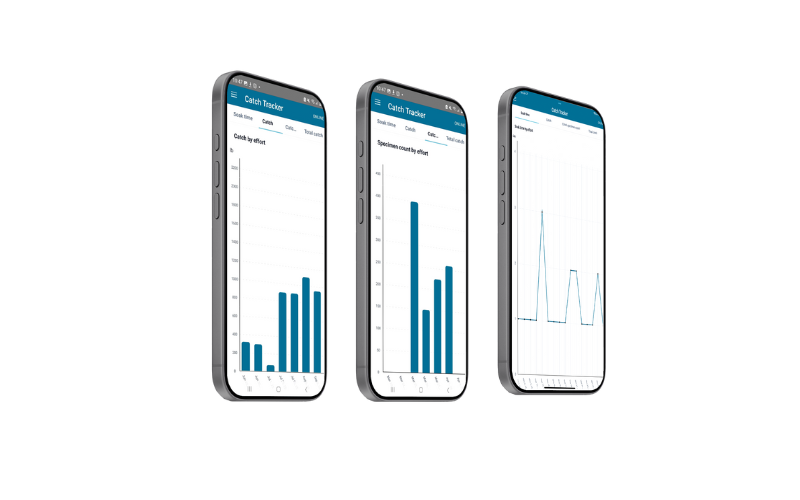
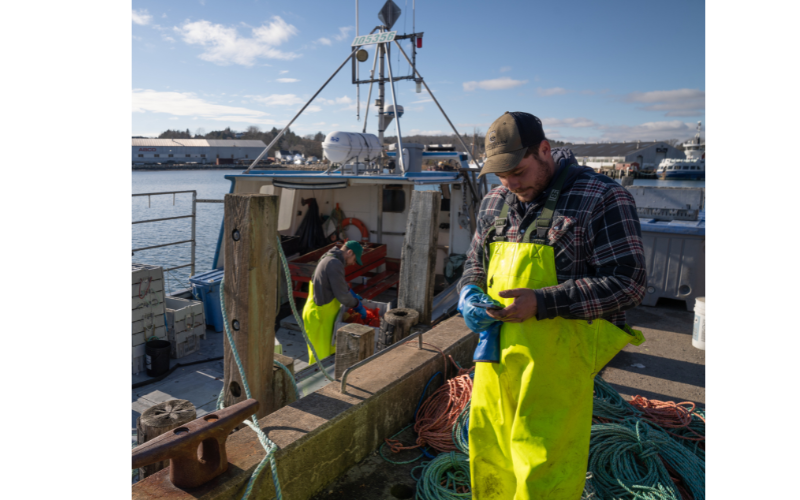
But change is happening. In 2025, electronic logbooks (ELOGS) became mandatory for all lobster harvesters in Newfoundland, Prince Edward Island, and Quebec, as well as in the Gulf regions of Nova Scotia and New Brunswick. Vericatch saw thousands of harvesters subscribe to our ELOG service, and over 100,000 ELOG submissions were electronically transferred to Fisheries and Oceans Canada (DFO) with very few issues. Paper reporting is essentially gone in these fisheries, and now you would be hard pressed to find a lobster harvester eager to put pen or pencil to paper while at sea.
This change is accelerating, prompted not just by technological advancement but also by the federal government’s new bottom line. Vericatch enables customers to input, review, and send accurate data directly from their devices to government servers, where it can be properly organized and used. The need for DFO to hire teams of data entry clerks to leaf through logbooks, decipher handwritten notations, and enter them into the appropriate fields in spreadsheets is now gone. This is a positive, as it has been acknowledged internally at DFO that too many errors occur when inputting logbook information, making it of no real use to science or resource management.
In Budget 2025: Canada Strong, the federal government committed to cutting billions from operational costs. One of the strategies DFO will use to reduce costs and align with the new budget is to stop spending on manual data entry when reliable, tested digital fisheries management alternatives exist. As the budget documents state: “DFO will leverage…digital tools to modernize Canada’s fisheries management system. Reducing the use of burdensome paper-based tools will free up time for fisheries officers to spend in communities and on the water enforcing fisheries regulations.”
The DFO mandate for commercial fishing ELOGs will expand in 2026, and reducing paper-based systems is now a clear budget requirement. ELOGs continue to be a tool of harvester empowerment, ensuring that information is captured accurately and used in stock assessments, science, and management decisions. We’ve long said it’s better to have your information counted and put to work than recorded in a paper logbook that may never be considered at all.
FAQs: Electronic Logbooks and Budget 2025
Are electronic logbooks (ELOGs) mandatory in Canada?
ELOGs are already mandatory for lobster harvesters in Newfoundland, Prince Edward Island, Quebec, and the Gulf regions of Nova Scotia and New Brunswick. DFO has confirmed that commercial fishing ELOG requirements will expand in 2026.
How does Budget 2025 affect commercial fisheries reporting?
Budget 2025 directs federal departments to reduce operational costs. For DFO, one of the clearest ways to do that is to move away from paper-based reporting. Using electronic logbooks reduces manual data entry, improves accuracy, and frees officers to spend more time on the water.
Why is DFO replacing paper logbooks?
Paper logbooks are vulnerable to damage, difficult to read, and slow to process. DFO has acknowledged that transcription errors during manual data entry can make some information unusable. ELOGs eliminate this step by sending accurate data directly to DFO systems.
What are the benefits of ELOGs for harvesters?
ELOGs help ensure a harvester’s information is counted, stored properly, and included in science and management decisions. They also remove the burden of maintaining paper logbooks at sea and reduce the risk of errors or missing entries.
Will more fisheries move to ELOGs?
Yes. With Budget 2025 prioritizing digital tools and cost-saving measures, the transition will continue. More commercial fisheries are expected to adopt mandatory electronic logbooks in 2026 and beyond.